to our
newsletter
Urban areas face increasing climate change risks. Understanding citizens' perceptions and barriers to adaptation is crucial. Phase I examines how people perceive gradual versus disruptive risks and their information needs. Phase II integrates these insights into scenario evaluations and develops effective communications for citizen adaptation.
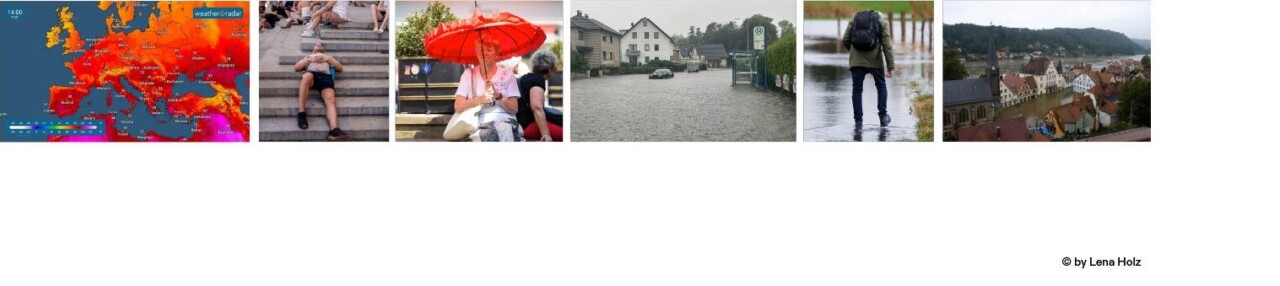
In Phase 1, the personal experiences of citizens regarding the risks posed by climate change in their everyday lives will be examined. The obstacles to adaptation will become clear from these findings, and these can then be considered and integrated into the scenarios of the other WPs.
Based on the findings from phase 1, the scenarios of the other WPs will be evaluated from the perspective of the citizens. The results will be used to develop communication tools to help citizens understand the risks of climate change and adapt effectively.
Principal Investigators
Prof. Dr. Astrid Kause
CIT | PI, Co-Speaker UCFL
Institute of Sustainability Psychology (ISP)
Leuphana University Lüneburg
www.leuphana.de/en/institutes/isep.html
Prof. Dr. Astrid Kause is Juniorprofessorin für Nachhaltigkeitswissenschaft und Psychologie at Leuphana University of Lüneburg. There she leads the Urban Future Climate Lab (UFCL, 2024–2030) project and the IMPETUS4CHANGE project (I4C, 2022–2026), advancing near-term climate prediction and societal transformation. Her interdisciplinary research combines sustainability science, metacognition and climate communication, with recent articles in Personality and Individual Differences, Climatic Change and Science Communication. She has studied public understanding of climate terminology and collective intelligence in science outreach. Kause regularly contributes to media on mental resilience and uncertainty communication in climate discourse and teaches on behavior change and risk perception.

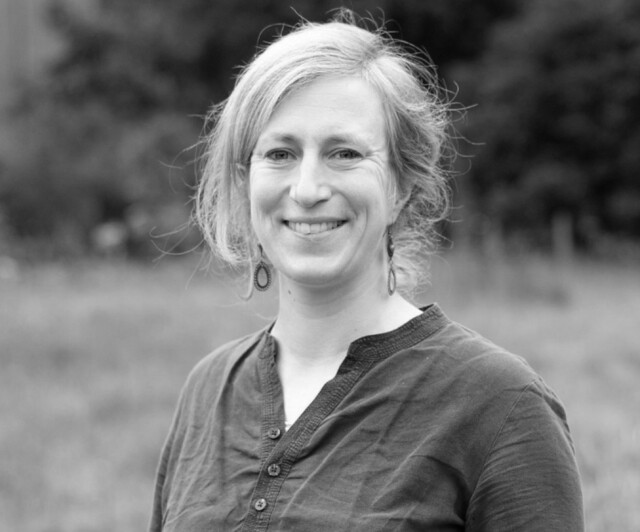
Lena Holz
CIT | PhD candidate
Institute of Sustainability Psychology (ISP)
Leuphana University Lüneburg
www.leuphana.de/en/institutes/isep.html
Lena Holz is a sustainability psychologist and PhD researcher at the Institute for Sustainability Psychology at Leuphana University Lüneburg. She obtained a Bachelor’s degree in Psychology from Radboud University Nijmegen and a Research Master’s degree in Behavioural and Social Sciences from University of Groningen, both in the Netherlands. Specializing in Environmental Psychology, her master’s thesis focused on climate anxiety as a psychological response to climate change. Within UCFL, her research examines how citizens in urban areas perceive and narrate risks related to climate change.
Citizens are often inadequately prepared for the threats posed by climate change, as risks are often over- or underestimated and communication does not usually seem to be effective because it is not adapted to the target group.
PI Kause has extensively studied climate change risk perceptions and relevant behaviours to understand how decision-makers understand climate change projections. She is also the leader of the interdisciplinary EU Horizon project Impetus4Change, which focuses on climate change adaptation in four European cities.
●Holford, D.; Fasce, A.; Tapper, K.; Demko, M.; Lewandowsky, S.; Hahn, U.; Abels, C. M.; Al-Rawi, A.; Alladin,
S.; Boender, T. S.; Bruns, H.; Fischer, H.; Gilde, C.; Hanel, P. H. P.; Herzog, S. M.; Kause, A. et al.
(2023): Science Communication as a Collective Intelligence Endeavor: A Manifesto and Examples for Implementation.
In: Science Communication, 45 (4), S. 539-554.
●Kause, A.; Bruin, Bruine de Bruin; Persson, J.; Thorén, H.; Olsson, L.; Wallin, A. et al. (2022): Confidence
Levels and Likelihood Terms in IPCC Reports: a Survey of Experts From Different Scientific Disciplines. In:
Climatic Change 173 (1-2), S. 1-18. http://dx.doi.org/10.1007/s10584-022-03382-3
●McDowell, M.; Kause, A. (2021): Communicating Uncertainties About the Effects of Medical Interventions
Using Different Display Formats. In: Risk Analysis 0 (0). https://doi.org/10.1111/risa.13739
●Taylor, A. L.; Kause, A.; Summers, B.; Harrowsmith, M. (2019): Preparing for Doris: Exploring Public Responses
to Impact-Based Weather Warnings in the United Kingdom. In: Weather, Climate, and Society 11
(4), S. 713–729. https://doi.org/10.1175/WCAS-D-18-0132.1
●Kause, A.; Bruine de Bruin, W.; Domingos, S.; Mittal, N.; Lowe, J. A.; Fung, F. (2021): Communications
About Uncertainty in Scientific Climate-related Findings: A Qualitative Systematic Review. In: Environ. Research
Letters 16.
●Kause, A.; Bruine de Bruin, W.; Fung, F.; Taylor, A.; Lowe, J. A. (2020): Visualizations of Projected Rainfall
Change in the United Kingdom: An Interview Study About User Perceptions. In: Sustainability 12 (7), 2955.
https://doi.org/10.3390/su12072955
●Kause, A.; Townsend, T.; Gaissmaier, W. (2019): Framing Climate Uncertainty: Frame Choices Reveal and
Influence Climate Change Beliefs. In: Weather, Climate, and Society, S. 199–215. https://doi.org/10.1175/WCAS-D-18-0002.1
●Kause, A.; Vitouch, O.; Glück, J. (2018): How Selfish is a Thirsty Man? A Pilot Study on Comparing Sharing
Behavior with Primary and Secondary Rewards. In: PLoS ONE 13 (8), S. 1–11. https://doi.org/10.1371/journal.pone.0201358
●Galesic, M.; Kause, A.; Gaissmaier, W. (2015): A Sampling Framework for Uncertainty in Individual Environmental
Decisions. In: Topics in Cognitive Science 8 (1), S. 242–258. https://doi.org/10.1111/tops.12172
●Kause, A. & Kütt, M. What Remains to be Done to Achieve Open, Global Science. Invited keynote at Open
World Conference 2022, University of Copenhagen, DK.
●Millward-Hopkins, J., Kause, A. & Bruine de Bruin, W. Even concerned consumers don’t know which food
choices have the lowest climate impact. The Conversation. Accessed via https://theconversation.com/even-concerned-consumers-dont-know-which-food-choices-have-the-lowest-climate-impact-132692?utm_source=clipboard&utm_medium=bylinecopy_url_button
●Kause, A., Bruine de Bruin, W., Fung, F., & Lowe, J. Communicating climate projections: A behavioral science
approach for studying perceptions of extreme weather in the UK. Presentation and stakeholder discussion
at the Met Office, Exeter, UK.
●Kause, A.. When water is scarce we’re willing to share what we really need – new research. The Conversation.
Accessed via https://theconversation.com/when-water-is-scarce-were-willing-to-share-what-we-really-need-new-research-104868?utm_source=clipboard&utm_medium=bylinecopy_url_button
●Bortoleto, A. P.; Kause, A.; Katsikopoulos, K. (2014): Waste prevention behaviour and fast and frugal heuristics.
In: Ana Paula Bortoleto (Hg.). 1. Aufl.: Routledge, S. 168–187.